How to Cat-Proof Your Christmas Tree
November 13, 2019 · Updated October 20, 2026
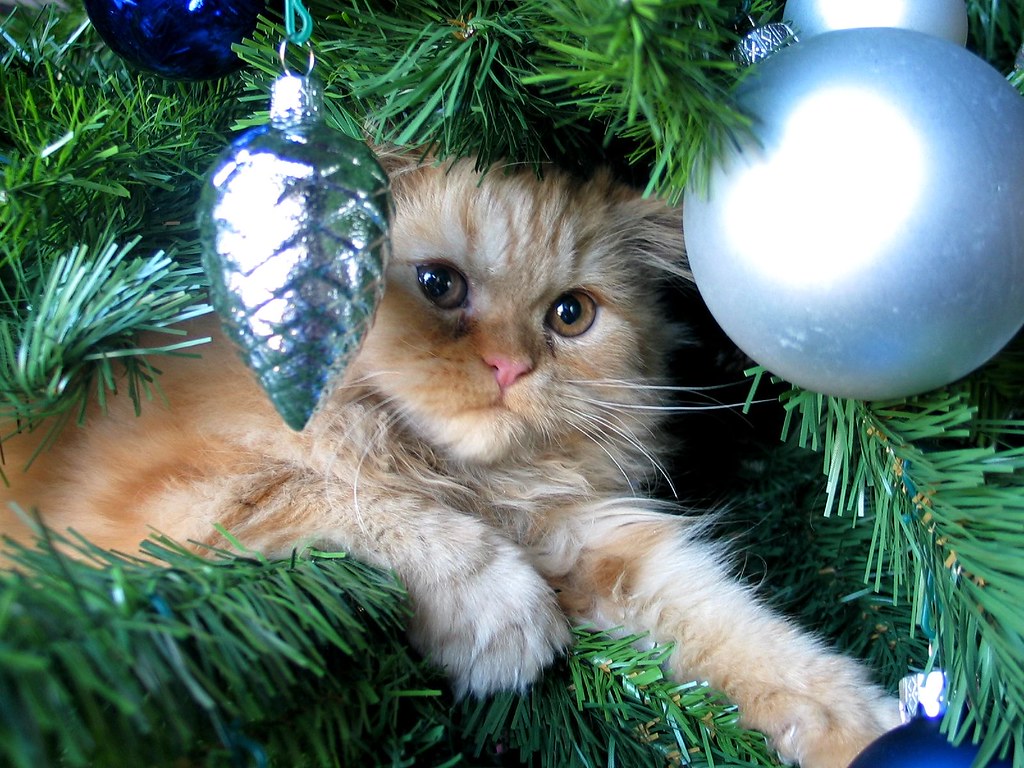
Updated October 2026: this article first ran in November 2019. It has been rewritten: the static “scat mat” it once suggested is gone, the things that actually send cats to the emergency vet come first, and holiday plants and open doors have been added.
To a cat, a Christmas tree is a climbing frame hung with toys. The tree itself is rarely the dangerous part. What hangs on it, what runs under it and what sits beside it is, and that is where this guide starts.
The real emergencies
Tinsel, ribbon, string and garland. Cats swallow these, and they do not pass. One end catches in the stomach or the gut while the rest keeps moving, the intestine pleats up around it like an accordion, and the strand can saw through the wall. Vets call it a linear foreign body; the fix is usually surgery. Leave tinsel, angel hair and ribbon off the tree and out of the wrapping, keep the curling ribbon in a drawer, and pick up every scrap after the presents are opened.
If your cat has eaten any of it, phone your vet straight away, or the nearest emergency hospital if they are closed, even if the cat seems fine. If you can see a piece hanging from the mouth or the bottom, do not pull it; pulling is how the strand cuts. Do not try to make the cat vomit. Vomiting, retching, a cat that stops eating, hides or cries when picked up means it is already causing trouble.
Light cords. A cat that bites a live cord burns its mouth, and fluid can build up in the lungs as late as 12 to 36 hours afterwards, so a cat that seems fine after a shock still needs a vet the same day. If you find your cat on a cord, switch the power off before you touch either of them. Run the cords through a rigid cover, tape them to the floor along the wall, unplug the lights when nobody is in the room, and check the strings for chewed spots before plugging them in. A bitter pet spray on the cords puts some cats off and does nothing for others; it is a nudge, not a barrier.
Lilies. Not on the tree, but in the holiday bouquet. Every part of a true lily (Asiatic, Easter, Oriental, stargazer and tiger lilies) and of a daylily can cause kidney failure in a cat: a chewed leaf, pollen licked off the fur after brushing past, even water from the vase. If treatment starts more than about 18 hours after a cat has been at one, the kidney damage is usually permanent. Keep lilies out of the house altogether, and tell whoever sends you flowers. A cat that has touched one goes to the vet now, with the plant.
Set the tree up so it stays up
- Bare first. Put the tree up with nothing on it and leave it for a few days. Most cats lose interest once the novelty wears off, and a bare tree is a safe one to explore.
- Anchor it. Use the widest, heaviest stand you can, and tie the top to a hook screwed into a wall stud or the ceiling with fishing line or wire. A climbing cat should not be able to bring it down.
- Place it well. A corner, away from the couch, the bookcase and anything else a cat can launch from, in a room with a door you can close when you are out.
- Cover the water. The stand of a real tree collects sap, whatever the tree was sprayed with, and bacteria as the days go by, and drinking it means an upset stomach. Skip the preservatives and the old aspirin trick. Wrap the reservoir in foil or a tree skirt the cat cannot get under.
- Sweep up the needles. Fir, spruce and pine needles are not very poisonous, but their oils irritate the mouth and stomach, and a cat that eats a lot of them can end up with a blockage or a punctured gut. Artificial needles are plastic and do the same. A few chewed needles usually mean drooling or a vomited breakfast; a cat that keeps vomiting, or stops eating, needs the vet.
Decorate for a cat
- The bottom third stays plain. Nothing fragile, nothing dangling, nothing edible within a paw's reach. Soft, unbreakable baubles down low; glass and the small, precious things up high.
- Tie, do not hook. A wire hook swallowed with a bauble is a second trip to the vet. Knot ornaments to the branch with a short piece of twine instead.
- Skip the edible and the salty. Popcorn or cranberry strings are string and food in one, the worst of both. Salt-dough ornaments are a salt overdose if eaten. Chocolate ornaments are chocolate.
- Snow globes up high or not at all. Some imported snow globes contain antifreeze, and a few licks from a broken one can kill a cat. If one breaks and the cat was near it, that is a vet visit now, not a wait-and-see.
- No scented oils in the tree room. Simmer pots and liquid potpourri can burn a cat's mouth with a few licks and bring on fever and tremors, and cats are especially sensitive to pine oil. Battery candles beat wax ones too: a flicked tail knocks a candle over, and a cat can burn itself.
- Forget the repellent spray. The 2019 version of this article said to spritz the tree with cat repellent. Don't. Many of those sprays rely on citrus or other essential oils, and essential oils are a hazard for cats in their own right. If you want something underfoot that cats avoid, a sheet of foil or a plastic carpet runner, nubs up, around the base does the job and hurts nothing.
The deterrent we no longer recommend
In 2019 this article suggested a static mat, the kind that gives a small shock when stepped on. We have dropped it. The feline veterinary association's own guidance says a mat like that “will likely cause fear-anxiety and additional undesirable behaviors”, and that punishment in general makes a cat harder to teach and can break down the relationship between you. Management works better: anchor the tree, keep the tempting things off the lower branches, give the cat a climbing tree of its own nearby so it has somewhere to go, and close the door when you cannot watch.
Other holiday plants
- Poinsettia: mostly a myth. The sap irritates the mouth and can cause drooling or a vomit, and that is usually it.
- Holly and mistletoe: vomiting and diarrhea, and mistletoe can also upset the heart's rhythm. Keep the berries picked up and call the vet if any were eaten.
- Amaryllis: the whole plant, the bulb most of all: vomiting, drooling, belly pain, tremors. Keep it out of reach.
- Christmas cactus: not toxic. The one you can leave at floor level, though a big mouthful of any plant can come back up.
- Lilies: see above. Never in a house with a cat.
Guests and open doors
Parties are when indoor cats get out: a door held open for a coat, a guest who does not know the cat stays in. Before people arrive, set the cat up in a quiet room with food, water, a litter box and a bed, close the door and put a note on it. Check that the collar is on and that the microchip registration still has your current number.
A Petbook tag on the collar turns a found cat into a message: whoever finds them scans it, sees your cat's page with the name and the photo, and can reach you from there, without an app or an account. Create a free account and add your cat before the first guests arrive.
If something goes wrong
Your own vet first; after hours, the nearest emergency hospital. Two poison lines take calls from Canada around the clock, for a fee: Pet Poison Helpline, 1-855-764-7661, and the ASPCA Animal Poison Control Center, 1-888-426-4435. Have the plant, the packet or the broken thing beside you when you call. Never make a cat vomit at home unless a vet tells you to.
Sources
- Pet Poison Helpline, Cats and Christmas Trees and Winter Holiday Pet Poison Tips (tinsel and ribbon, tree water, snow globes, liquid potpourri, holiday plants), and the handout Essential Oils and Cats.
- Pet Poison Helpline, No Lilies for Kitties (which lilies, pollen and vase water, the 18-hour window).
- VCA Animal Hospitals, Holiday Safety Tips for Cat Owners and Ingestion of Foreign Bodies in Cats.
- MSPCA-Angell, Electrical Cord Injury (the delayed fluid in the lungs; switching the power off first).
- Feline Veterinary Medical Association (formerly the AAFP), Training Techniques for Addressing Undesirable Behaviors (punishment and static mats).
- ASPCA Animal Poison Control, the toxic and non-toxic plants list: poinsettia, English holly, amaryllis and Christmas cactus.
Photo: Tunde Pecsvari, Flickr (CC BY-NC-ND 2.0).