The Problem With Cat Food Bowls
June 30, 2019
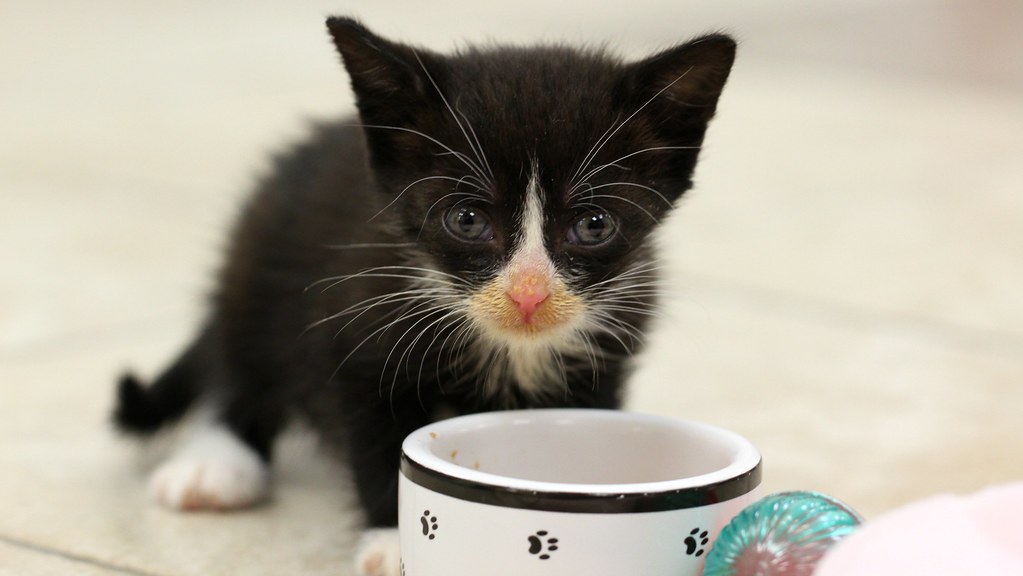
Ever noticed how your cat leaves food in their bowl every time they eat, usually smooshed up against the sides or flattened to the bottom? Even if you’re feeding your cat dry food, he’ll probably abandon any kibble pushed into the corner or over the sides. So what’s going on? Is it the food? Is it because they’re finicky eaters? Or is there a more scientific explanation?
Whenever I take care of my handsome feline friend Stallone, I notice that he only eats his food from the very centre of the bowl and in the process, manages to make more mess and waste than progress. He gets canned food, so I thought I’d experiment and pile his food into a pyramid shape to see if he’s able to eat more. It worked!
Somewhat. There was still a lot of neglected food leftover, stuck to the bowl.
Maybe it was just too large a portion and he’d eat it later. But he never did. More food would go down the garburator than down his gullet! So I began to wonder whether it had something to do with the bowl itself. A quick search on the Internet told me that indeed there is a problem with cat food bowls. It has to do with how your cat is designed.
The problem with cat food bowls
When your cat is face down in his bowl chowing down, he can’t actually see what he’s eating, so he uses his nose to source out the food, pushing it around and up against the sides and into the corners. In other words, just out of kitty’s ergonomic reach. To venture further means either planting his face in it or pressing his whiskers against the bowl, both of which result in a messed-up face.
Whisker fatigue
Your cat’s whiskers act like antenna helping them to interpret their outside world, and are incredibly sensitive to everything happening around them. At the base of your cat’s whiskers are sensory organs which help him to judge space and distance. When overstimulated on a daily basis, like in trying to eat out of a bowl that’s the wrong size and shape, your cat is susceptible to a condition known as whisker fatigue. If left untreated, your cat may refuse to eat as she associates it with discomfort and stress.
The right cat food bowl makes all the difference
To make Kitty’s dining experience more comfortable:
- Find a cat food bowl that is big enough for her lovely face and whiskers.
- Make sure your cat food bowl is germ-proof and washed after every feeding.
- No plastic food bowls, only stainless steel, glass or ceramic.
- Buy a bowl that is shallow enough food won’t get caught along the edges.
- Consider feeding your cat smaller, more frequent servings throughout the day.
Find a cat food bowl that is wide but shallow, and preferably stainless steel for hygiene. If you search online, you can find plenty of products designed specifically for ergonomic cat dining. The same goes for your cat’s water bowls.
So your cat might not be a finicky eater after all. It could be your cat’s food bowl is all wrong and your cat is experiencing whisker fatigue. Try using different bowls that are ergonomically designed for your cat’s ultimate comfort, and see if that makes a difference to his dining experience.
Photo by: Kerri Lee Smith ~ Rapidash