Toronto winter guide for dogs: salt, ice melter, how cold is too cold
November 22, 2014 · Updated November 10, 2026
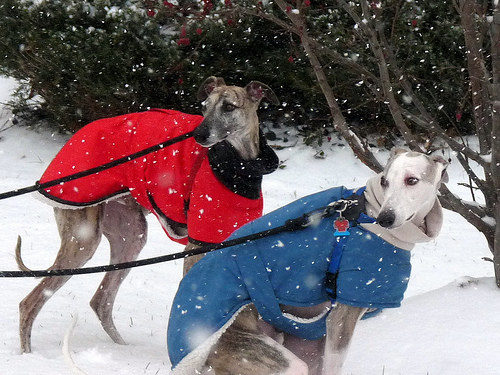
Updated November 2026: this article first ran in November 2014 as “Cold Weather Tips to Keep Your Canine Safe”, by Aileen Schultz. It is now a Toronto winter guide for dogs. Her tip to melt ice out of paw fur, not pull it, is kept, and a veterinarian backs it. We found nothing in the old version to withdraw. It lacked a temperature guide, warning signs, rules and phone numbers.
How cold is too cold for a dog?
There is no single number. Size, coat, age, health, wind and wet all change the answer, and so does time outside. The guide follows two veterinary sources: Fetch's chief veterinary officer, Dr. Aliya McCullough, and veterinarian Jennifer Coates, writing for Chewy. Both give plain temperatures. Wind speeds up heat loss, so our own advice is to read the chart by the feels-like temperature, the one with wind chill, on a windy day.
| Temperature | Small, thin-coated, young, old or sick dogs | Large, thick-coated, healthy adult dogs |
|---|---|---|
| About 7°C (45°F) | Can feel chilled. Use caution. | Probably fine. |
| About 0°C (32°F) | At risk of hypothermia and frostbite. | Most dogs begin to be at risk. Walks in rain, wind or fog are not a good idea. |
| About −7°C (20°F) and colder | Higher risk. Keep walks to about 10 minutes. | Higher risk too. Watch even a cold-tolerant dog closely, and keep walks to about 10 minutes. |
| Any cold warning from Environment Canada or Toronto's Medical Officer of Health | Legally “extreme weather” in Toronto. A dog left outdoors must have a shelter that protects it. | |
Our advice: a big dog with a short, thin coat belongs in the left column. Chewy says to keep walks to 10 minutes or less at minus 7°C.
Mental Floss says Fetch's chart is modelled on a scale developed by Tufts University. The Tufts Animal Care and Condition scales, which include a weather safety scale, were designed by veterinarian Gary Patronek to help investigators judge whether a dog was being neglected, and a 1998 article presenting them calls them a screening device, not a replacement for a veterinarian's assessment, so treat every line above as a rough guide. The Tufts scale adds risk for toy dogs, puppies under six months, old dogs and rain or sleet, and lowers it for northern or heavy-coated breeds, dogs used to the cold and dogs with good shelter.
What makes a dog feel the cold more?
- Wind and wet. Wind pushes through the coat, and a wet dog loses heat faster.
- Coat. Long hair does not always mean warm. Single-coated dogs such as whippets get cold easily, and the Ontario SPCA names dachshunds, French bulldogs and Boston terriers as short, thin-coated breeds.
- Age and health. Puppies and senior dogs are at higher risk, and so are dogs with diabetes, arthritis, kidney problems or heart disease.
What are the signs of hypothermia and frostbite in dogs?
The Ontario SPCA lists signs of a dog getting too cold: shivering, whining, lifting or licking its paws, a tucked tail, walking slowly and shallow breathing. Head home.
Hypothermia means the body temperature has dropped below normal. Watch for shivering, cool ears and paws, pale gums, confusion, sluggishness and stiff, clumsy movement. Do not rely on shivering: it can stop as hypothermia gets worse.
Frostbite most often hits the paws, ears and tail, and a wet dog is more at risk. The skin may look pale, grey or bluish and feel cold. The damage can take several days to show.
A dog that is very sluggish, has trouble walking, collapses, stops responding, or has stopped shivering and still feels cold is an emergency: call your veterinarian or an emergency clinic now. Do the same if you think your dog has hypothermia or frostbite. While you call, bring the dog inside and wrap it in dry towels or blankets. Do not rub the skin, do not use a heating pad or hair dryer, and give no medicine unless your veterinarian tells you to. Keep the dog wrapped on the way to the clinic.
Is sidewalk salt bad for dogs' paws?
It can be. In Toronto, City crews clear public sidewalks once 2 cm of snow has fallen and the snow has stopped. The City uses road salt, and it salts residential streets once snow starts to build up.
Most ice melters are built on salts: sodium chloride (rock salt), potassium chloride, magnesium chloride, calcium salts or urea. The Pet Poison Helpline calls calcium salts the most severe irritants of the lot, on the skin and paws as well as in the stomach. Licking a little off the paws usually causes no more than an upset stomach or sore skin, but the ASPCA warns that ice melter licked off bare paws can make winter walks dangerous. PetMD lists the signs to watch for: drooling, vomiting, diarrhea, belly pain and bloating, and, if the dog took in a lot of rock salt, tiredness, weakness, unsteadiness, muscle twitches or seizures. Large amounts of salt can be deadly, and the deadly dose goes by body weight, so a small dog needs far less than a big one. If your dog eats ice melter or shows any of these signs, call your veterinarian or an emergency clinic now.
After every winter walk:
- Rinse and wipe each paw, between the toes and around the large central pad. Dry the feet and belly.
- Check the pads for cracks and the skin between the toes for redness. Red or irritated feet, a rash, constant licking or a dog walking gingerly all mean a visit to your veterinarian.
Is pet-safe ice melt really safe?
Safer, not safe. Products sold as pet-safe usually contain urea or magnesium chloride. PetMD, in an article reviewed by a veterinarian, says these are slightly safer but can still upset a dog's stomach and melt less ice, and that no ice melt is entirely pet-safe. The Pet Poison Helpline adds that large amounts of urea can still make a dog ill. Use a pet-friendly product on your own steps and driveway, store the bag where your dog cannot reach it, and keep wiping paws, because the sidewalk down the street is probably salted with something else.
Does my dog need boots or a coat?
A coat helps short-haired, small, young, old and thin dogs. The ASPCA says never to shave a dog down to the skin in winter. For a long-haired dog, trim the coat instead, including the hair between the toes, so less ice and salt clings to it.
Boots protect against cold, sharp ice, ice melter and the snowballs that pack between the pads. Some dogs refuse them or chew them off, and a swallowed piece can block the gut, so watch a new wearer. The ASPCA suggests massaging petroleum jelly or a vet-approved paw protectant into the pads before you go out, says boots give even more coverage, and advises washing and drying the feet and belly after each walk. Watch that your dog does not lick it off.
For what the collar should carry, see our guide to collars, tags and microchips.
How do I get ice balls out of my dog's paws?
Melt them. Do not pull. Pulling the ice out hurts, and a dog in pain may nip. Pennsylvania veterinarian Jeffrey Berman suggests a washcloth soaked in warm water to speed up the melting while you gently massage the ice away, then checking the paws and pads for cuts. This is the trick from the 2014 version of this article, which had you rub your fingers on the ice to melt it. If your dog tries to chew the ice out itself, wipe its paws first, in case it walked through ice melter.
Why is antifreeze dangerous for dogs in winter?
Most car antifreeze is ethylene glycol. It tastes sweet, and a tiny amount can poison a dog. The Merck Veterinary Manual says the poisoning is often fatal and, in cold climates, seasonal. American makers have added a bittering agent since 2012, but Merck notes that some animals may still drink it. VCA Animal Hospitals says it also turns up, in lower amounts, in some windshield de-icers. The Pet Poison Helpline adds that pets meet antifreeze from leaking vehicles, containers in garages and winterized RV plumbing, and that not every antifreeze contains ethylene glycol, so find out which kind you have.
Wipe up drips in the garage and driveway, keep containers closed and out of reach, and think about a propylene glycol product, which the ASPCA suggests instead. Merck says propylene glycol is less toxic but can still make a dog ill if swallowed, so store it just as carefully.
Merck says a poisoned dog can look drunk, vomit and be very thirsty within 30 minutes to 12 hours, may then seem to recover, and goes into kidney failure 36 to 72 hours after drinking it. The sooner treatment starts, the better the chance. If you know or even suspect your dog drank antifreeze, call your veterinarian or an emergency clinic now, even if it looks well. Do not wait for signs: by the time they appear, the outlook is very poor.
Can I leave my dog outside in the cold in Toronto?
Only with proper shelter, and never during a cold warning without it. Toronto's Municipal Code, Chapter 349, says: “No person shall allow an animal to remain outdoors during extreme weather unless the animal has access to an enclosure that will adequately protect the animal from the elements.” Extreme weather means a cold, heat or other weather warning for Toronto from Environment Canada or the City's Medical Officer of Health. The City lists a 300-dollar fine for it.
In any weather, Chapter 349 also says:
- A dog kept outside on your property for more than 30 minutes at a time needs a weather-proofed, insulated shelter.
- A tether must be at least three metres long, never with a choke collar, choke chain or pronged collar as part of it, and no animal may be tethered unsupervised for more than one hour.
- Water must be at a drinkable temperature.
Ontario's standards for dogs kept outdoors (O. Reg. 444/19 under the PAWS Act) apply when a dog is outside continuously for 60 minutes or more without you. The dog must be protected from cold-related distress, its water must not be frozen, it must be groomed to avoid a build-up of ice on its coat or under its paws, and a dog whose illness affects how it controls its temperature must not be kept outdoors unless a veterinarian approves in writing. Bedding must be at least three inches thick.
A car is no shelter either. The ASPCA warns that a car can hold the cold like a fridge.
How does Toronto announce an extreme cold warning?
Through Environment Canada. Since November 2025, its warnings, advisories and watches come in three colours: yellow, orange and red (rare and possibly life-threatening). The City points residents to Environment Canada and its WeatherCAN app. The City's own page still gives an older minus 30°C trigger, but Environment Canada now uses impact guides, so watch for the warning itself, not a number.
For your dog, any cold warning is the Chapter 349 line: indoors, or in real shelter.
Who do I call about a dog left out in the cold in Toronto?
- A life in immediate danger, such as a dog left alone in a car in the cold: call 911.
- A dog left outdoors in extreme weather in the city: call 311 for Toronto Animal Services, which says it answers these complaints on a priority basis.
- An animal in distress or being neglected anywhere in Ontario: call the Ontario Animal Protection Call Centre at 1-833-9-ANIMAL (264625), open 24 hours a day. Anonymous calls are not accepted.
Is it safe to let my dog on frozen ponds or the lake?
No. Toronto and Region Conservation Authority says ice is never 100 percent safe, ice conditions are not being monitored, and family and pets should stay away from all bodies of water, including frozen reservoirs and the ice around dams and channels. Keep your dog on a leash near ponds, rivers and the lakeshore.
From November 1 to March 31, Chapter 608 lets dogs off leash below the snow fence at Kew-Balmy Beach and Woodbine Beach. Call your dog back before it reaches the water's edge.
How do I keep my dog safe on dark winter walks?
The Ontario SPCA suggests reflective clothing and other gear, a working flashlight, keeping your dog leashed and a fully charged phone. Ice is also hard on joints: a dog that slips can injure a knee ligament, so take icy stretches slowly. Off your property, Chapter 349 requires a leash no longer than two metres, except in designated off-leash areas of City parks.
Do more dogs get lost in winter?
The ASPCA says so: a dog can lose its scent in the snow and become lost, and it advises never letting a dog off leash on snow or ice, especially in a storm. It gives no figures. Keep an ID tag on the collar, and if your dog does go missing, start searching right away. Our guide to a missing cat's first 24 hours in Toronto is written for cats, but much of it applies to dogs too.
How Petbook can help
A Petbook account is free, and each pet gets a page with its name and photo. The Petbook tag is a QR code on the collar. Whoever finds your dog scans it with a phone camera and sees that page, without an app or an account.
If your dog goes missing, Report lost on its page alerts your followers and creates a public alert page, live for 30 days. With a city and province on the alert, it also appears on the public lost pets board, where anyone can report a sighting without an account. The alert page has a Make a poster button that prints a one-page poster with the photo and a QR code that opens the alert. While the dog is reported lost, a scan of its tag e-mails you, and its page shows a Tell their family link so whoever has your dog can let you know at once.
The Petbook tag is not identification: it is not a licence, a microchip or proof of ownership. Join free and add your dog.
Sources
- Fetch, How Cold Is Too Cold for Dogs? (Dr. Aliya McCullough).
- Chewy, How Cold Is Too Cold for Dogs? (Jennifer Coates, DVM; reviewed by Hannah Hart, DVM).
- Mental Floss, This Handy Chart Tells You When It’s Too Cold to Walk Your Dog (updated January 2026).
- Patronek G, Animal Sheltering, July-August 1998, Tufts Animal Care and Condition scales.
- Ontario SPCA and Humane Society, Safety tips for winter walks.
- PetMD, Hypothermia in Dogs and Things to Know About Pet-Safe Ice Melts.
- VCA Animal Hospitals, Frostbite in Dogs and Ethylene Glycol Poisoning in Dogs.
- Pet Poison Helpline, Is there really a safe ice melt? and Antifreeze.
- Merck Veterinary Manual, Ethylene Glycol Toxicosis in Animals and Propylene Glycol Toxicosis in Animals.
- ASPCA, Cold Weather Safety Tips.
- PetSafe, Keep Your Dog Safe in the Snow (2012; Dr. Jeffrey Berman quoted).
- City of Toronto, Municipal Code Chapter 349, Animals (s. 349-1 extreme weather, s. 349-6, s. 349-7, s. 349-8, s. 349-12.1) and Chapter 608, Parks (s. 608-34; the City's posted consolidation of June 3, 2024).
- City of Toronto, Animal Enforcement and Assistance (fines) and the cold weather response, November 2025 version.
- City of Toronto, Extreme Cold Weather.
- City of Toronto, Sidewalk Clearing, Salting and Plowing Roads and Salt Management.
- Government of Ontario, O. Reg. 444/19, Standards of Care and Administrative Requirements and Animal welfare.
- Environment and Climate Change Canada, Colour-coded weather alerts, the November 2025 announcement and Weather Impact Guides.
- Toronto and Region Conservation Authority, Winter Safety.
Cover photo: yooperann, Flickr, licensed CC BY-NC-ND 2.0.