Doggie Devices and The New Age of Pet Healthcare
July 13, 2015
by Natalie Secretan
When my dog Layla was really young, I would use my FitBit to gauge how much exercise to give her in a day. She’s a very active dog that requires a lot of exercise. I settled on 10,000 to 15,000 human steps as the optimum number. Anything less and she would still be full of beans and very restless.
The other day I decided to attach my FitBit to her collar to see if it would track her steps. We went for one of our usual walks in the park where I knew for me was a 6,500-step journey.
Like most puppies her age, Layla doesn’t walk in a straight line. The power of her nose and the allure of the scent have her going in all different directions. So for every three of my steps she’s dashed around, picked up bits of debris, chewed on a stick, chased a butterfly and paused for a nano-second to smell the flowers before returning to mom and the regular check-in and a High-5! (if I’m lucky!)
So, you shouldn’t be surprised to learn that by the end of the walk, my 6,500 human steps translated into 21,000 steps for Layla the Beagle/Springer Hound, age 1 year!
Seems like my brilliant idea of attaching my FitBit to Layla’s collar wasn’t the only one floating out there. Betsy Fore, founder and CEO of Wondermento, the creator of WonderWoof, designed a health tracking device for her dog, Whiskey, after his vet put him on a diet and ordered rigorous exercise.
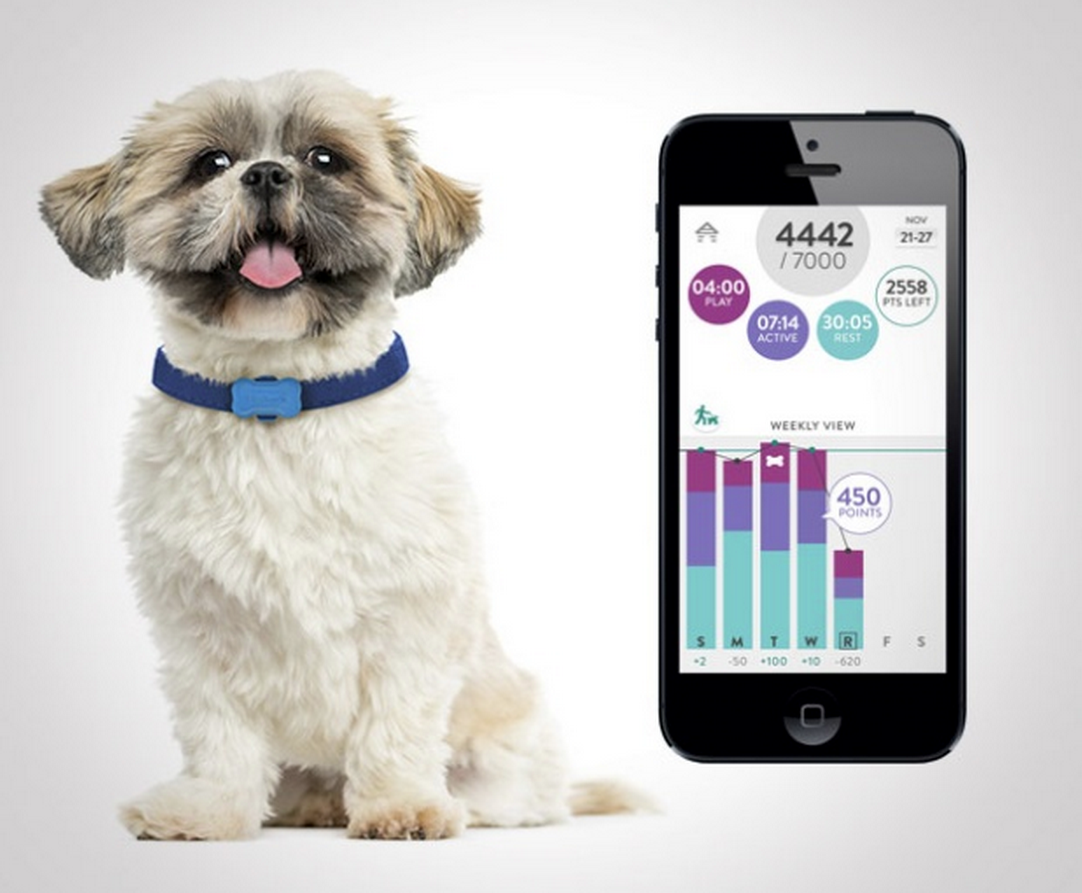
Like most health-tracking devices, the WonderWoof allows you to track walking, sleeping and playing! (Something the human fitness trackers lack!) You can also create fitness goals for your dog based on their weight, age and breed. You and your dog will also receive prompts like motivation on your lazy days and praise on your active days. It’s an ideal and serious way to get your dog on the right track to good health.
The really exciting thing about these doggie devices is that with all this data now being collected through technology from dog owners of all sorts of different breeds, we’re now understanding our dogs better. Co-founder and CEO of FitBark, Davide Rossi, says:
“We wanted to create a tool that would improve communication between the dog and its owner. It was a reaction to my personal frustration of not being able to answer the question, ‘how’s my dog doing today?’”
So, for instance, if your dog wakes up several times during the night, which the tracker will monitor, it may be because he is experiencing pain through the night and will help to explain his lack of energy during the day. This information can be extremely helpful when consulting with your vet. In fact, Rossi is using his trackers to help vets monitor dogs in poor health. He says:
“We make it possible to monitor if a product that you’re using for improving that condition is actually working or not.”
There are many pet trackers now on the market, so if you’re going to invest – shop around. Most of the devices I’ve seen go for $99.
Source: http://www.theguardian.com/lifeandstyle/2015/jun/20/internet-of-pets-technology-track-dog-fit
Photo source: FitBark