How Old Is Your Dog Really?
July 13, 2020

Ask anyone how old their dog is and they’ll immediately turn to that popular rule of 1:7. If my dog is four years old, then that’s the same as 28 in human years. Science has just proven this belief to be a myth.
But why is this important?
Just as you would familiarize yourself with the stages of development in children, so too is it important to know the age of your dog. Knowing what stage of life your dog has entered can help you determine what kind of health care they need. For example, if your four-year-old dog is much older than believed, changing their diet, modifying their exercise regimen, and prescribing medication or supplements for joint health are just a few things you can do to promote anti-aging and longevity.
The 1:7 Dog Year Rule Is Obsolete
To find out just how quickly a dog ages compared to humans, scientists from the University of California San Diego studied the DNA of 104 labrador retrievers over their lifetime. Genomes across different species experience similar molecular changes due to the aging process and the researchers were able to come up with a more accurate formula to determine a dog’s age in human years.
Based on the changing patterns of methyl groups in the genomes of dogs and humans as they age, the formula compares chemical tags and their location along the genetic sequence. It’s a much more accurate way of determining age.
Known as ‘epigenetic changes’, these chemical modifications can determine the age of a cell, tissue or organism based on a readout of its epigenetics much like an ‘epigenetic clock’.
Trey Ideker, lead researcher of the study and professor at UC San Diego School of Medicine and Moores Cancer Center says, “Epigenetic changes provide scientists with clues to a genome’s age, much like wrinkles on a person’s face provide clues to their age.”
Ideker chose dogs in the study as they live so closely with humans, sharing their lifestyle and environment, they are subjected to similar life situations and so make good test subjects.
In labrador retrievers, the study showed that a one one-year-old dog is similar to a 30-year-old human and a four-year-old dog is similar to a 52-year-old human. As you can see in the graph, aging slows down in dogs after age seven.
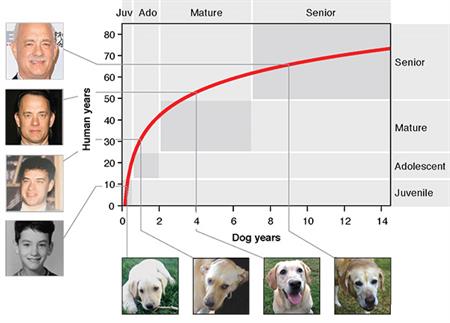
The findings of the study will prompt further research into anti-aging treatments to help dogs live a longer, healthier life. These findings can also help the medical field understand anti-aging strategies for humans.
What isn’t clear from the study is how aging affects different breeds of dogs. This epigenetic formula can vary even between different humans, so more research is needed to find the aging differences in various breeds of dogs. As we all know, Chihuahuas live a lot longer than the Great Dane, so it makes sense their epigenetic clocks would be substantially different.
What we can learn from this study is how to treat dogs differently as they age. Maybe now is a good time to introduce some joint health supplements into their diet or change their dog food to a more senior formula. Maybe going out with you for your 20km jog in the morning is not ideal for Rover anymore. Maybe short, frequent walks would serve him better and help his aging joints. Food for thought.
Sources:
- UC SanDiego Health: How Old Is Your Dog in Human Years?
- Cell Systems: July 02, 2020 DOI: 10.1016/j.cels.2020.06.006