The Red-Eyed Tree Frog: An Evolutionary Wonder
November 23, 2015
By Natalie Secretan
Frogs are such cheery little characters with their wide-mouth grins, funny legs and captivating eyes. As a kid, I couldn’t resist the delightful creatures hopping around freely in most of my friends’ back gardens. Many a frog spent a night in my house. I would capture all kinds of critters – frogs, toads, grasshoppers, ladybugs, caterpillars, mice, rabbits – study them for an evening and then let them go in the morning.
In some folklore, frogs are known as the communicators of the forest with their ritual twilight chirping, burping, and grunting. If you’re lucky enough to live near a pond or marsh and have heard this froggy chorus, you know how loud and mesmerizing it can be. If there are enough frogs, it will sound like a rowdy night at the local watering hole, everybody catching up on the news of the day and the woodland gossip worth knowing!
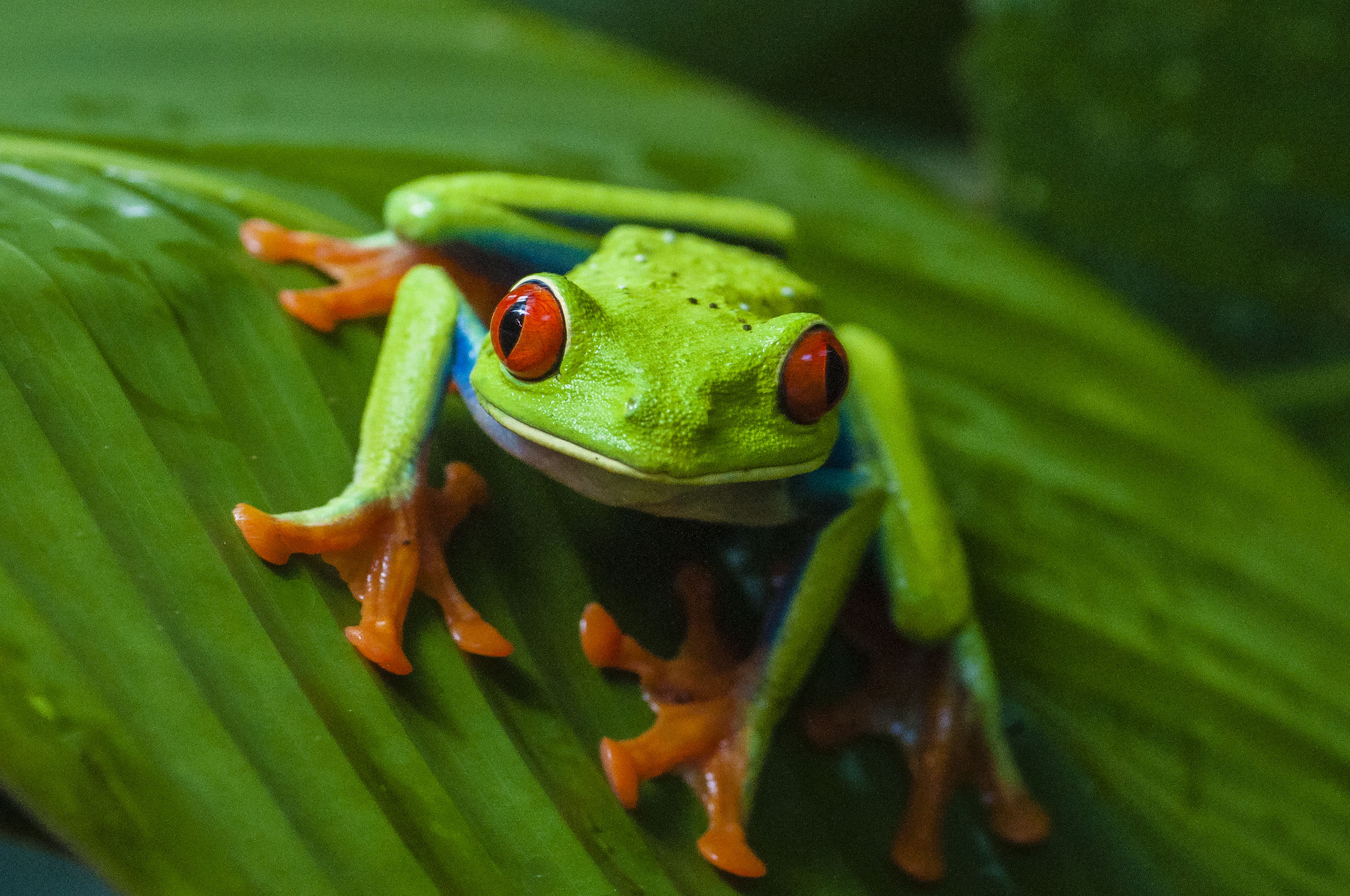
The idea of keeping frogs as pets occurred to me again the other day. So I decided to do some research. I’ve always loved the Red-Eyed Tree Frog. This colourful little fellow has become somewhat of a pop culture sensation, and is loved by almost everybody. Its colourful body certainly plays to its advantage, and is one reason why this clever little frog has survived more than 250 million years.
Its brilliant ultra-glow of bright leafy green, orange, yellow, blue, and ruby-red eyes acts as a safeguard to startle prey. When a Red-Eyed Tree Frog leaps to safety he leaves behind an iridescent trail, fooling his enemy into thinking he’s a sitting duck, and hasn’t gone anywhere. In the daytime, when the Red-Eyed Tree Frog sleeps, he tucks himself up to conceal his brightly coloured flanks and pulls the shades down on his striking red eyes – safely camouflaged in the canopy foliage.
Those ruby-red eyes help the Red-Eyed Tree Frog to see in all directions, but they also help in digestion. This sounds kind of gross at first, but when you study your frog you’ll notice he shuts his eyes whenever he swallows a morsel of food. The eyeballs actually recede and help move the food into the belly rapidly, so he can eat on the fly or should I say, bounce!
Another reason the Red-Eyed Tree Frog has survived for millions of years is his amazing sense of sound. This little creature is wired for sound! With two eardrums tucked behind his eyeballs and an inner ear located in his chest, he feels the vibrations of a snake long before they’re face to face. At which point, he knows it’s time to bounce!
Despite its ability to survive in the wild, the Red-Eyed Tree Frog is quite sensitive and fragile in captivity, and not recommended for the first-time batrachophile or froggyphile.
Sources:
Photo Credit: Danel Solabarrieta